
Kabaddi: From the Clay Arena to the Global Screen
प्रश्न: कबड्डी क्या है और इसका महत्व क्यों बढ़ा है? उत्तर: कबड्डी सात-सात खिलाड़ियों की दो टीमों के बीच खेला जाने वाला संपर्क खेल है, जिसमें रेडर को तीस सेकंड के भीतर लगातार 'कबड्डी' का उच्चारण करते हुए विरोधी पाले में जाकर खिलाड़ियों को छूकर लौटना होता है; यह 1982 में एशियाई खेलों में प्रदर्शनकारी और 1990 में पदक स्पर्धा बना। इसका महत्व तीन कारणों से बढ़ा: फ्रैंचाइज़ी आधारित पेशेवर लीग ने इसे वित्तीय रूप से टिकाऊ करियर बनाया, ईरान जैसी टीमों के उभार ने प्रतिस्पर्धा की गहराई बढ़ाई, और 2010 से महिला वर्ग को अंतरराष्ट्रीय मान्यता मिली। प्रमुख चुनौतियां हैं — पारदर्शी शासन, खिलाड़ी कल्याण और चिकित्सा सुरक्षा, लीग-राष्ट्रीय टीम कैलेंडर का समन्वय, तथा भारत से बाहर स्थायी जमीनी ढांचे का निर्माण। ओलंपिक में शामिल होना इसका वास्तविक पैमाना नहीं; असली मापदंड यह है कि खेल कितने देशों में स्थानीय स्तर पर खेला और प्रशिक्षित किया जा रहा है।
In any Indian village, as evening falls, one of the first scenes visible is two teams standing on an open field with a line drawn between them. No ball, no bat, no net. Just seven players, one breath, and thirty seconds of audacity. Kabaddi is one of the few sports in the world that requires no equipment to play — only air in the lungs and strategy in the head. This simplicity has been the sport's greatest strength, and the irony is that for decades this same simplicity kept it away from serious sports journalism and global investment.
Over the past two decades, that picture has fundamentally changed. Kabaddi is no longer merely rural Indian entertainment. It is a television product, a franchise economy, a permanent fixture in the Asian Games programme, and a sport that several countries are trying to make part of their national sporting culture. Understanding this shift requires looking from the inside of the sport outward — first the rules, then the competitions, then the market.
The sport's inner logic: a thirty-second gamble
Kabaddi's basic rule is simple. Seven players from each team are on the mat. When a player's turn comes, that player — called a raider — enters the opponent's half and keeps chanting 'kabaddi-kabaddi' continuously. This chant is not merely tradition but a technical requirement: the moment the breath stops, the raid is considered over. The raider must touch opposing players and return to their own half within thirty seconds. If they return, each touched player is out and points are scored. If the defenders catch them and they fail to return, the raider is out.
Within this simple framework arises the complexity that is the sport's real intellectual layer. For the defending side, the entire mat is a trap — they must lunge together, but lunging together means that if the raider slips away, several players can be out in a single raid. When all seven defenders are out, it is called a 'lona' and bonus points are awarded. One wrong decision can turn the entire match. This is why strategy matters as much as physical ability in kabaddi. In modern coaching, video analysis, the study of opposing raiders' patterns, and the fine judgement of when to lunge have become as important as a player's strength.
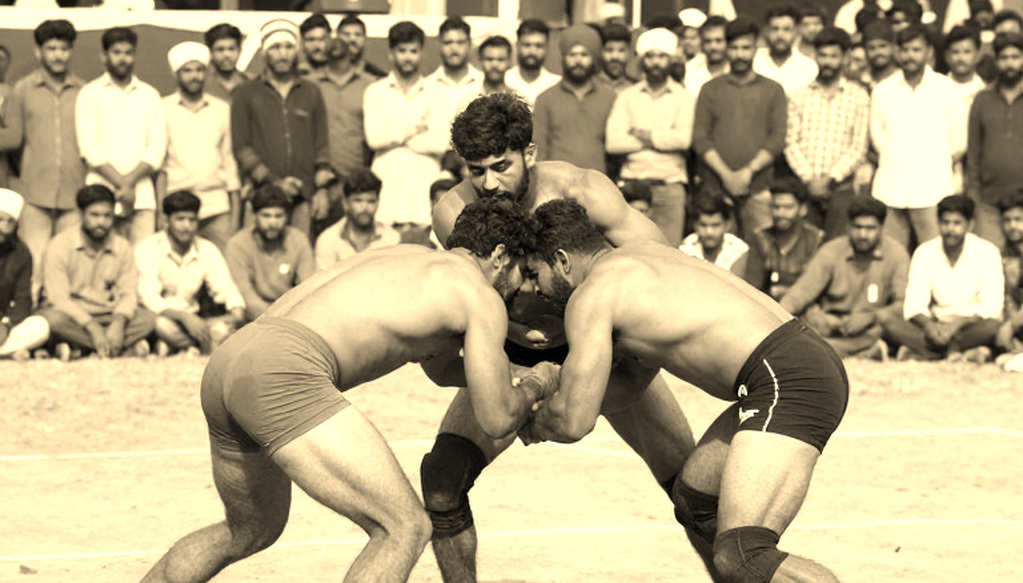
Another characteristic of the sport is its democratic character. Playing it requires no expensive equipment, special venue or large investment. Flat mud, a little space and seven companions are enough. This is why kabaddi took root even in parts of South Asia where the basic infrastructure for other sports never reached. But this same characteristic also became an obstacle to institutional development — when a sport does not need to be made expensive, the priority for commercial investment takes time to form.
The long road through the Asian Games
Kabaddi's first major international recognition came at the 2026 Asian Games in New Delhi, when it was included as a demonstration sport. Eight years later, at the 2026 Asian Games in Beijing, it became a medal event. That moment was decisive, because it moved the sport from the category of 'local tradition' to that of 'national prestige'. Government funding, the involvement of sports authorities and the standardisation of rules all began after this.
Over the three decades that followed, the history of kabaddi at the Asian Games has largely been a unipolar story — Indian dominance in the men's category. Technical discipline, a deep player pool and domestic competition long made the Indian team the natural favourite. But this dominance also created an interesting paradox: when one country keeps winning, the sport's global appeal shrinks. Kabaddi's administrators realised late that the sport's future rests not on India winning, but on the depth of competition.
This is why Iran's rise in recent years should be seen not merely as the story of a rival, but as a sign of the sport's health. The Iranian team gave kabaddi a place in its national sporting system, drew players from wrestling and other strength sports, and brought new intensity to defensive play. The result is that India has begun to face genuine challenges at Asian and world level. The participation of countries such as Bangladesh, South Korea and Kenya has further widened this process.
The politics of the rulebook
The changes to kabaddi's rules were not merely technical — they were directly linked to broadcasting and commercialisation. Revisions to the scoring system, the reworking of the raid time limit and efforts to adapt match duration to television were all steps in this direction. When a sport is made broadcastable, its pace, its pauses and its drama must be designed. Traditional kabaddi could be slow in rhythm; broadcasting demanded speed.
This process has a negative side too. When rules change according to the market, the local diversity that kept the sport alive for centuries is affected. Different regions had different forms of kabaddi — in some the time limit differed, in others the size of the field, in others the standard team size. Standardisation made international competition possible, but it also pushed local forms to the margins. This debate continues in sports administration today, and it cannot simply be called reactionary — it is a question of who the sport is for.
The franchise era: when kabaddi became a market
The change that came in the second decade of the twenty-first century is considered the biggest economic turning point in kabaddi's history. The launch of a franchise-based professional league turned the sport into a system in which private capital, auctions, contracts and television rights came together. For players, it was the first time that playing kabaddi could yield an income capable of sustaining a career. Many players emerged whose stories began in rural backgrounds and reached large stadiums and advertising campaigns.
The league's greatest contribution was not technological but cultural. It freed kabaddi from the image of a 'small-town sport' and established it as an entertainment product watched by big-city audiences too. Music, DJs, commentary and star culture were added to stadiums. There was opposition to this change as well — older sports lovers said the sport was losing both its simplicity and its seriousness. But the economic logic was clear: without a professional structure, neither investment would come nor would continuity of talent be built.
The league also widened the scope of employment — coaches, physiotherapists, data analysts, scouts and broadcasters. This is a side that is discussed less. A sporting ecosystem expands not only through star players; it depends on a whole chain of support professionals. In kabaddi, that chain was almost absent before.
League versus national duty
Every professional sport faces this tension: franchise interests and national team priorities collide. In kabaddi it is especially visible because the league's broadcast calendar and the international competition calendar often do not align. The injury burden on players rises, rest periods shrink, and club managements remain anxious about protecting their investment during national camps.
The solution lies in institutional coordination, not in pressure from any one party. Sports that have struck this balance have done so through clear windows, insurance arrangements and injury-management protocols. For kabaddi's administrators, this is the next big test. If a player's livelihood depends on the league and national identity depends on international medals, both must be prioritised simultaneously — otherwise the player is forced to choose, and that choice is always damaging.
Women's kabaddi: a late turn
Women's kabaddi was included in the international competition programme much later than the men's game. The inclusion of women's kabaddi as a medal event at the 2026 Guangzhou Asian Games was a significant moment. After this, women's teams, training camps and competitions grew at both domestic and international levels.
But structural inequality remains clear. Financial rewards, broadcast time and sponsorship for women players have remained lower than for men. In many states, separate training facilities for women's kabaddi are not available. This is not only a question of justice but also of the sport's development — no sport can become global by excluding half the population. Countries that invested in the women's game also strengthened their position in international competition.
The politics of the grassroots: village, school and arena
Kabaddi's talent supply still comes mainly from rural and semi-urban areas. It is the most accessible route for children of families that cannot afford the costs of expensive sports. But because of this very accessibility, it was long undervalued as a 'poor man's sport', which meant talented players did not receive proper training and career guidance.
In recent years, state-level sports academies, school competitions and private scouting networks have narrowed this gap somewhat. But the imbalance persists. On one side are players who receive large sums at franchise auctions; on the other are those who, despite playing at state level, remain without a stable income. Bridging this divide is essential, because a sport's credibility is determined not by its summit but by the strength of its base.
Challenges that cannot be ignored
The first challenge is governance. Like many sports federations, kabaddi administration has at times faced questions over transparency, electoral processes and financial accountability. When private capital enters a sport, conflicts of interest enter too. Without clear rules, independent audits and player representation, it is impossible to build confidence that financial growth is reaching those who play on the mat.
The second challenge is player welfare. Kabaddi is a physically demanding sport — collisions, falls, knee and shoulder injuries are common. Careers are short. Medical insurance, rehabilitation support and planning for post-retirement careers are therefore essential. Some teams and organisations are working in this direction, but it is still the exception, not the rule.
The third challenge is doping and fairness. As prize money rises, the pressure to win rises, and the monitoring system must be strengthened in proportion. This is not merely a regulatory task but a question of the sport's credibility.
What global expansion really means
The demand to include kabaddi in the Olympic Games has been raised for a long time. It is an attractive slogan, but the conditions it requires are strict: a sufficient number of member national federations, geographic diversity, a stable competition calendar, transparent governance and a global audience base. Kabaddi has made progress on some of these, and on others it still has a long road to travel.
The real measure of global expansion is therefore not Olympic inclusion but how many countries play the sport on a sustained basis. If kabaddi arrives in a country only as an imported competition and develops no local roots, that expansion will not be durable. The real work is in local coaching, school curricula, national leagues and domestic talent development — this work is slow, invisible, and has no immediate broadcast value, but it is what will decide the sport's future.
Conclusion: let simplicity remain, let structure be built
The most interesting aspect of kabaddi's story is that it has taken the shape of a modern professional sport without losing its original identity. Even today it requires no equipment to play — just mud, space and seven companions. That heritage must be protected.
But simplicity must not be allowed to become an excuse for disorder. In the coming decade, kabaddi's real test will not be television ratings or auction sums. The test will be whether governance is transparent, whether women players get equal opportunity, whether domestic talent can build a sustainable career, and whether the sport's roots deepen outside India as well. If the answer to these four questions is yes, kabaddi will no longer be merely a popular sport — it will join the small group of sports that have built their own journey from local tradition to the global sports economy.